adsr
adsr · modulationGate-triggered attack-decay-sustain-release envelope. Outputs CV.
the faceplate
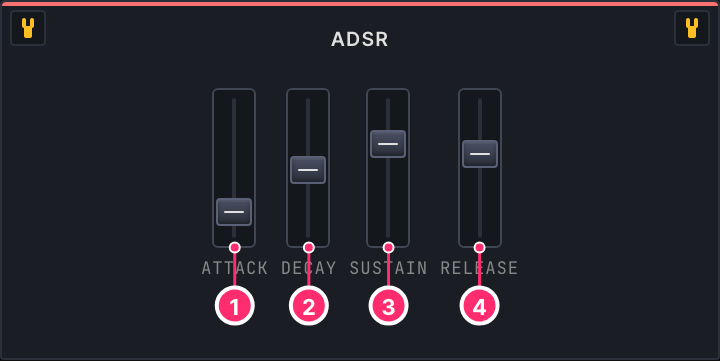
| # | control | what it does |
|---|---|---|
| 1 | A | How long the envelope takes to ramp from 0 to its peak (1.0) after the gate goes high — 1 ms up to 10 s on a log-scaled control, so most of the travel lives in the short, snappy times. The first stage of the contour: short reads as a click or pluck, long as a slow swell. |
| 2 | D | How long the envelope takes to fall from the peak down to the sustain level once the attack finishes — 1 ms to 10 s, log-scaled. Has no audible effect if sustain is at 1.0 (there is nothing to decay to). |
| 3 | S | The level the envelope holds for as long as the gate stays high, after attack and decay complete — 0 (no hold, decays all the way to silence) up to 1.0 (holds at full peak). A level, not a time — the only linear control of the four stages. |
| 4 | R | How long the envelope takes to fade from wherever it currently is back to 0 once the gate goes low — 1 ms to 10 s, log-scaled. The note's tail; it applies even when the gate drops mid-attack. |
inputs
| id | cable | what it does |
|---|---|---|
gate | gate | The note signal that drives the whole envelope: a rising edge (gate goes high) starts the attack stage, the level then decays to and holds at the sustain level WHILE the gate stays high (this input is level-sensitive, not just edge-triggered), and the falling edge (gate goes low) starts the release stage back to 0 — from wherever the level currently is, even mid-attack. Re-gating is a hard retrigger: a new rising edge snaps the output back to 0 and ramps the attack again from zero, it does NOT continue from the level it was at. gate / trigger; gate — acts while the level is high (reacts to both edges) |
attack | cv | CV that modulates the attack time: a -1..+1 signal scales it symmetrically in log time around your set value — ±1 multiplies or divides the time by 100x (two decades either way, clamped to the 1 ms..10 s range) — so an LFO here sweeps the attack from snap to swell centered on the control. control voltage (CV); modulates attack (multiplicative ≈ octaves — ±1 CV spans the param’s log range) |
decay | cv | CV that modulates the decay time the same way — a -1..+1 signal scales it symmetrically in log time (±1 = 100x faster or slower, two decades either way) around your set value, clamped to 1 ms..10 s. control voltage (CV); modulates decay (multiplicative ≈ octaves — ±1 CV spans the param’s log range) |
sustain | cv | CV that displaces the sustain level — linear, since the param is already a native 0..1 level: ±1 pushes the held level up or down by up to half the range (±0.5) around your set value, clamped to 0..1. control voltage (CV); modulates sustain (additive offset — ±1 CV sweeps the full range, centered on the knob) |
release | cv | CV that modulates the release time — a -1..+1 signal scales it symmetrically in log time (±1 = 100x faster or slower, two decades either way) around your set value, clamped to 1 ms..10 s. control voltage (CV); modulates release (multiplicative ≈ octaves — ±1 CV spans the param’s log range) |
outputs
| id | cable | what it does |
|---|---|---|
env | cv | The envelope itself as a unipolar 0..1 control signal — 0 at rest, ramping linearly to 1 at the attack peak, holding at the sustain level while gated, then fading to 0 on release. Patch into a VCA gain, filter cutoff, or any CV destination to shape it over each note. control voltage (CV) |
env_inv | cv | The inverted envelope, 1 - env: it sits at 1 at rest and dips toward 0 as the envelope rises (full env peak = 0 out). Patch into a VCA or filter to duck / reverse-modulate that destination on every note, sidechain-style. control voltage (CV) |
params
| id | label | range | default | curve |
|---|---|---|---|---|
attack | A | 0.001..10s | 0.005 | log |
decay | D | 0.001..10s | 0.1 | log |
sustain | S | 0..1 | 0.7 | linear |
release | R | 0.001..10s | 0.3 | log |
source
adsr.ts on GitHub.